
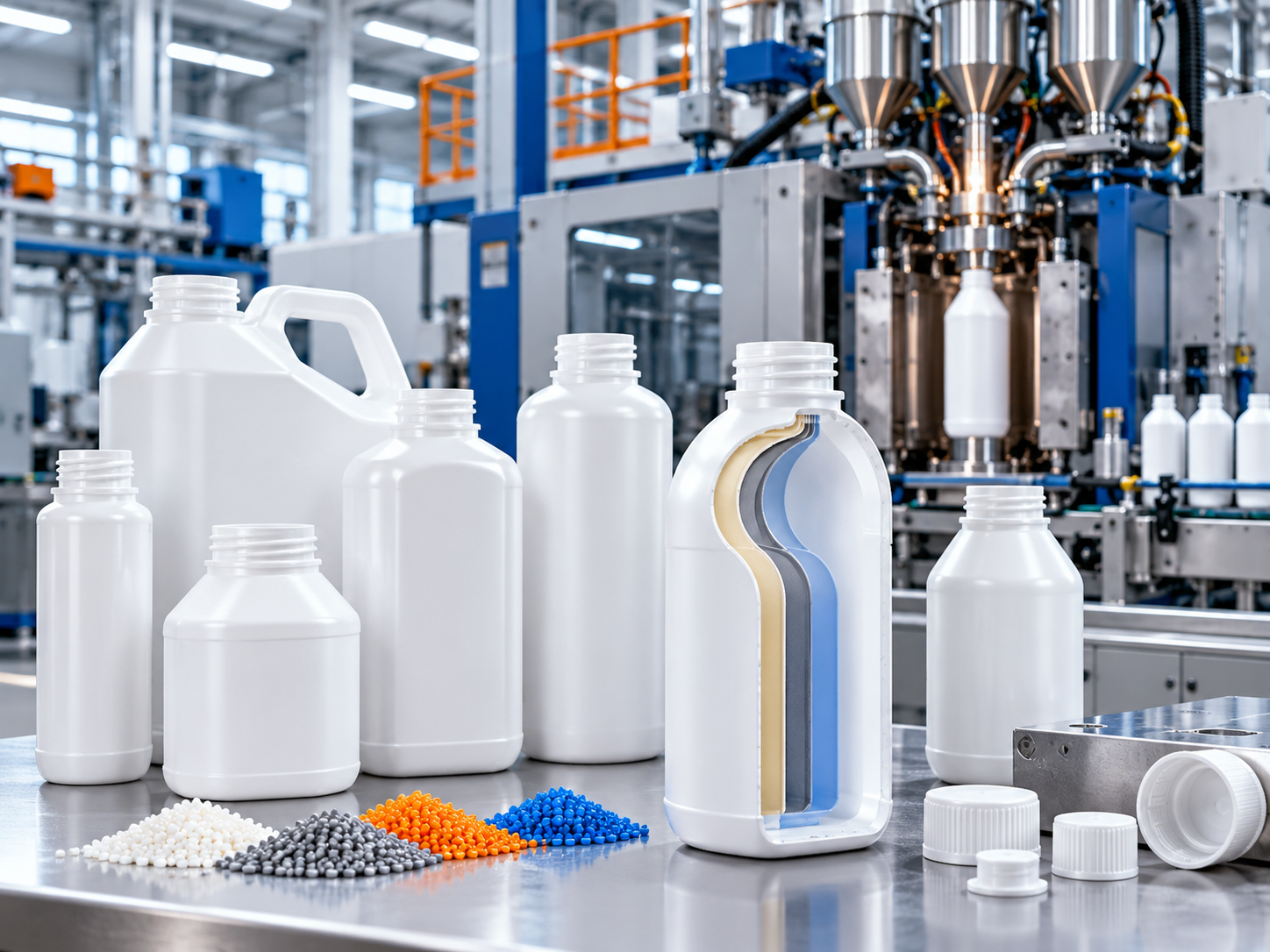
If you're packaging a product that can't afford to degrade, the phrase "COEX bottle" will come up. Here's what it actually means, how it's made, and why it matters.
What Does "COEX" Mean?
COEX stands for co-extrusion — the process of extruding two or more polymers simultaneously to form a single, unified container. Instead of one plastic wall, you get multiple distinct layers bonded together into one continuous structure.
Each layer has a job. Some layers provide structural strength. Some provide chemical resistance. And one layer — the critical one — carries the barrier material that protects the product inside.
How Blown Coextrusion Works
In blown coextrusion, multiple extruders feed different polymers into a single die head. The polymers flow out together as a single parison (a tube of molten plastic), which is then inflated with air inside a mould to form the final bottle shape.
The result: a bottle where the layers are molecularly bonded, not glued or coated. The barrier protection is built into the structure itself — not applied on top.
Why Multilayer Matters
Different products need protection from different threats. Moisture. Oxygen. Chemical exposure. Temperature swings. A monolayer bottle can only handle so much. A multilayer structure can be engineered to handle the specific combination your product faces.
Depending on the requirement, containers can be built with up to 4 layers of protection — each one selected to address a specific risk.
Key Barrier Properties
- Chemical resistance — protection against aggressive contained products.
- Waterproof performance — resistance against solvent-based formulations.
- High-temperature resistance — stability across storage and transport conditions.
- Moisture and oxygen prevention — barrier against permeation that could degrade sensitive contents.
Amber Polypack's Approach to COEX
At Amber Polypack, multilayer COEX technology is one of our core capabilities. We design and manufacture multilayer bottles using blown coextrusion — with up to 4 layers engineered around what your product needs to survive.
We work closely with customers in agrochemical, pharmaceutical and FMCG industries to determine the right layer structure, capacity and closure system for their specific application.
Have a product that needs barrier protection? Let's talk about the right layer structure for your formulation.
Discuss Your RequirementWhen to Choose COEX Over Monolayer
Not every product needs multilayer packaging. Monolayer bottles are simpler, lighter and often more cost-effective. But when your formulation is vulnerable to moisture, oxygen or chemical breakdown — or when shelf life and product integrity are critical — multilayer COEX packaging is the right choice.
A simple rule: if degradation of the contents would be a problem, it's worth asking whether COEX is the right solution.