
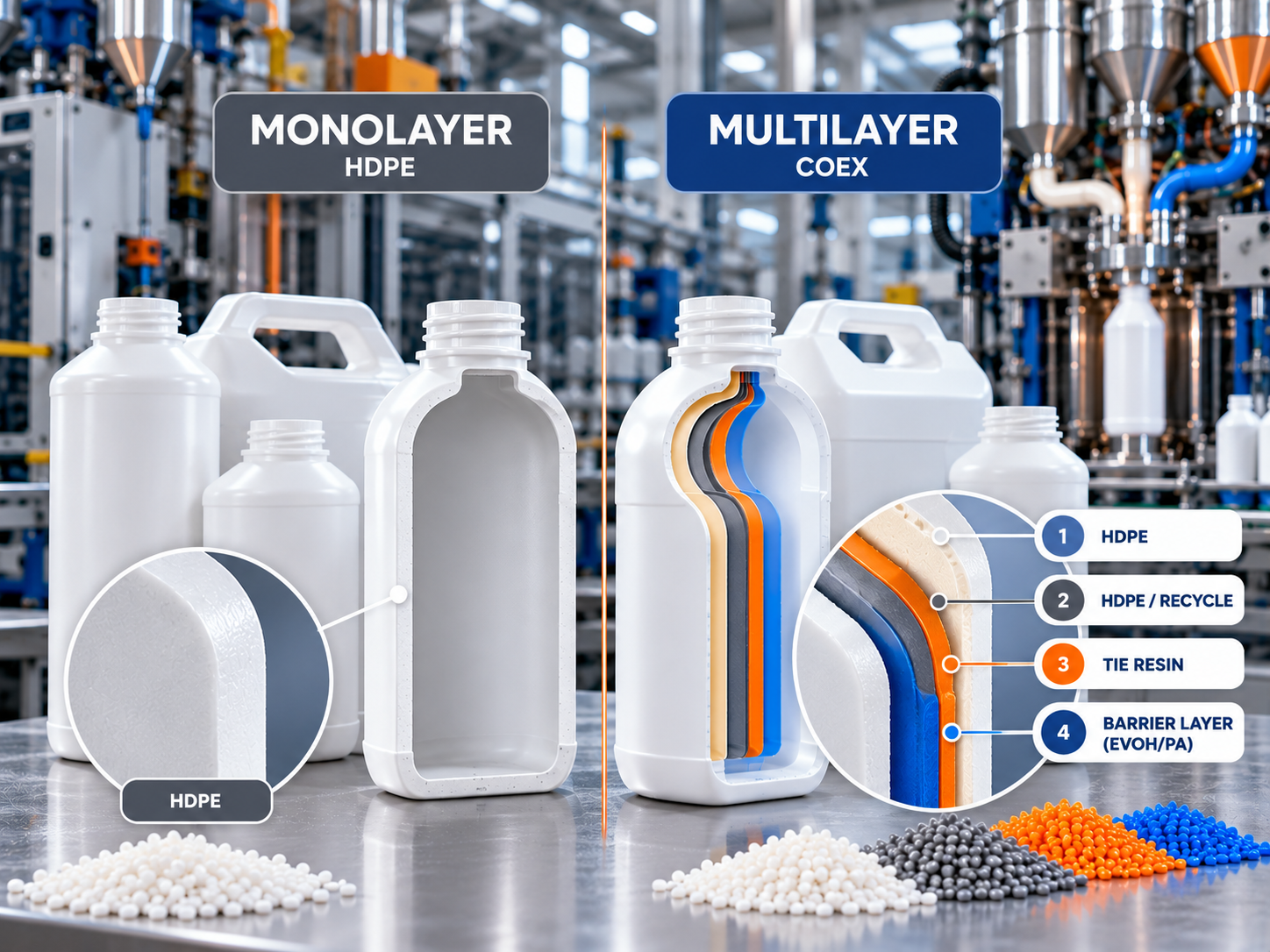
Not every product needs multilayer packaging. But choosing the wrong structure can cost you — either in unnecessary cost or in product degradation. Here's how to decide.
The Basic Difference
A monolayer bottle is exactly what it sounds like: a single layer of plastic forming the entire container wall. A multilayer bottle (often called COEX) is made by co-extruding two or more polymers simultaneously — creating a wall with multiple distinct layers bonded together.
Monolayer bottles are simpler, lighter and often more cost-effective. Multilayer bottles are engineered systems, with each layer selected for a specific performance purpose.
When Monolayer Packaging Is Enough
Monolayer bottles work well for a wide range of products. They're often the right choice when:
- The product is not sensitive to moisture or oxygen — for example, products with short shelf lives or stable formulations.
- Chemical resistance requirements are moderate — the container won't be exposed to aggressive solvents.
- Cost is a key driver — monolayer containers use less material and are simpler to produce.
- The product moves fast — FMCG applications with short cycles don't always need extended barrier performance.
For these cases, monolayer packaging delivers exactly what's needed without unnecessary complexity.
When Multilayer Packaging Is the Right Choice
Multilayer COEX packaging is engineered for products where protection is critical. It's the right choice when:
- The formulation is sensitive to moisture — humidity from outside would degrade the product.
- Oxygen exposure is a risk — active ingredients react with oxygen and lose efficacy.
- Chemical resistance is critical — aggressive solvents or concentrated actives attack the container from inside.
- Shelf life matters — products that sit in warehouses or on shelves for extended periods.
- Temperature swings are expected — storage and transport across varied climates.
In these cases, up to 4 layers of barrier protection can be engineered to address the specific risks the product faces.
A Simple Decision Framework
Instead of jumping straight to a technical comparison, start with these questions:
- What could degrade my product? Moisture, oxygen, light, temperature, chemical reaction?
- How long does the product need to last? Weeks, months, years?
- Where will the product be stored and transported? Climate, humidity, handling conditions?
- How critical is product integrity? Would degradation be a minor issue, or a serious problem?
If the answers point to significant risk of degradation, multilayer packaging is worth evaluating. If not, monolayer may be simpler and more cost-effective.
How Amber Polypack Helps You Choose
At Amber Polypack, we manufacture both monolayer and multilayer containers. Our EBM (Extrusion Blow Moulding) and IBM (Injection Blow Moulding) capabilities cover a wide range of options, so we don't push every customer toward multilayer — we help you choose the right structure for your product.
The decision comes down to what your product actually needs. We start by understanding your formulation, your shelf-life requirements and your distribution environment, then recommend the structure that delivers the right level of protection at the right cost.
Not sure which structure is right for your product? Talk to our team — we'll help you decide.
Discuss Your RequirementThe Takeaway
Monolayer and multilayer packaging aren't competing approaches — they're tools for different jobs. The right choice depends on what your product needs to survive, how long it needs to last, and how critical product integrity is to your brand.
Ask the questions, understand the risks, and the answer usually becomes clear.