
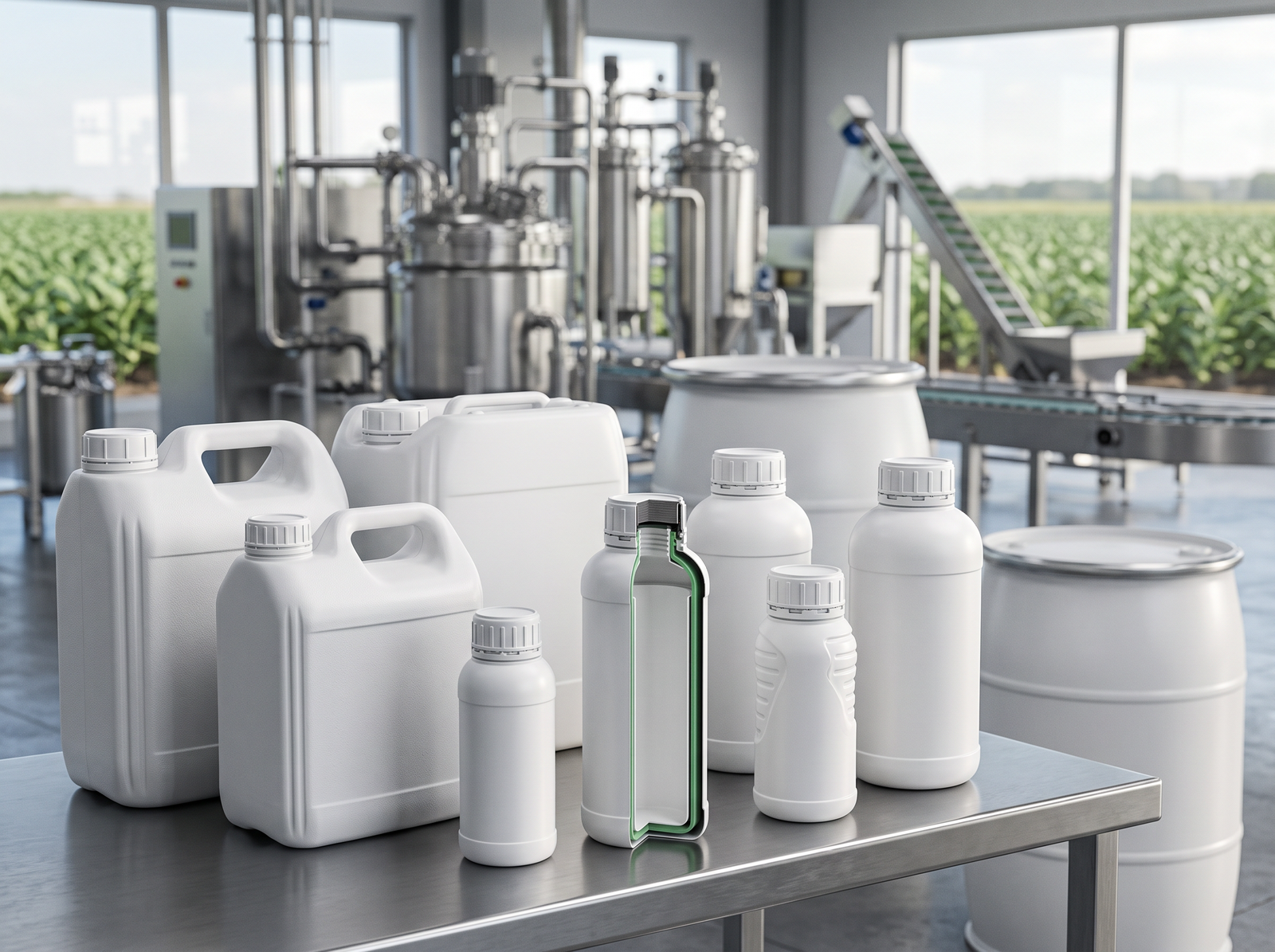
Agrochemical formulations don't fail in the field — they often fail in the package. Here's why barrier protection is the difference between a product that works and a product that degrades before it's used.
What Agrochemical Products Face
Agrochemical formulations — from liquid concentrates to emulsifiable oils — are exposed to a range of stresses throughout their lifecycle. Storage in warehouses where temperatures swing. Transport across regions with different humidity levels. Handling that includes stacking, dropping and long-term sitting.
Each of these stresses puts pressure on the packaging. And when the packaging can't hold up, the product inside begins to change.
The Three Enemies of Agrochemical Formulations
Most product degradation in agrochemical packaging comes down to three things:
- Moisture ingress — humidity from outside that passes through the container wall and contaminates the formulation.
- Oxygen permeation — oxygen that reacts with sensitive compounds and degrades product performance.
- Chemical incompatibility — aggressive solvents and active ingredients attacking the container from the inside out.
Each of these can compromise the product's effectiveness, shorten its shelf life, or worse — cause a compliance issue in the field.
How Multilayer Barrier Protection Works
Multilayer COEX (co-extruded) packaging addresses all three enemies at once. By combining multiple polymers into a single container — with one layer carrying the barrier material — the bottle becomes a barrier system, not just a vessel.
Depending on what the product needs to survive, containers can be built with up to 4 layers of protection. Each layer serves a specific function: structural strength, chemical resistance, moisture resistance, or oxygen blocking.
What Good Barrier Protection Delivers
- Product integrity across storage — formulations stay within specification from production to end use.
- Extended shelf life — less degradation over time, especially in humid or warm conditions.
- Chemical resistance — containers that hold up against aggressive contents without swelling, softening or leaking.
- Reliable performance in the field — the product works the way it was designed to work.
Amber Polypack's Approach to Agrochemical Packaging
At Amber Polypack, we design and manufacture multilayer COEX bottles specifically for agrochemical applications. Our team works closely with formulators and brand owners to determine the right layer structure, capacity and closure system based on the product's specific needs.
Every container we make for this market is engineered with one goal: protecting the formulation so it performs exactly as intended, from the factory to the field.
Packaging an agrochemical formulation? Let's talk about the right barrier structure for your product.
Discuss Your RequirementWhen to Choose Multilayer Over Monolayer
Not every agrochemical product needs multilayer packaging. Some formulations are stable enough for monolayer containers. But when the product is sensitive to moisture, oxygen or chemical breakdown — or when shelf life and field performance are critical — multilayer COEX packaging is the right choice.
A simple way to decide: if degradation of the formulation would be a problem, it's worth asking whether barrier protection should be built into the package.